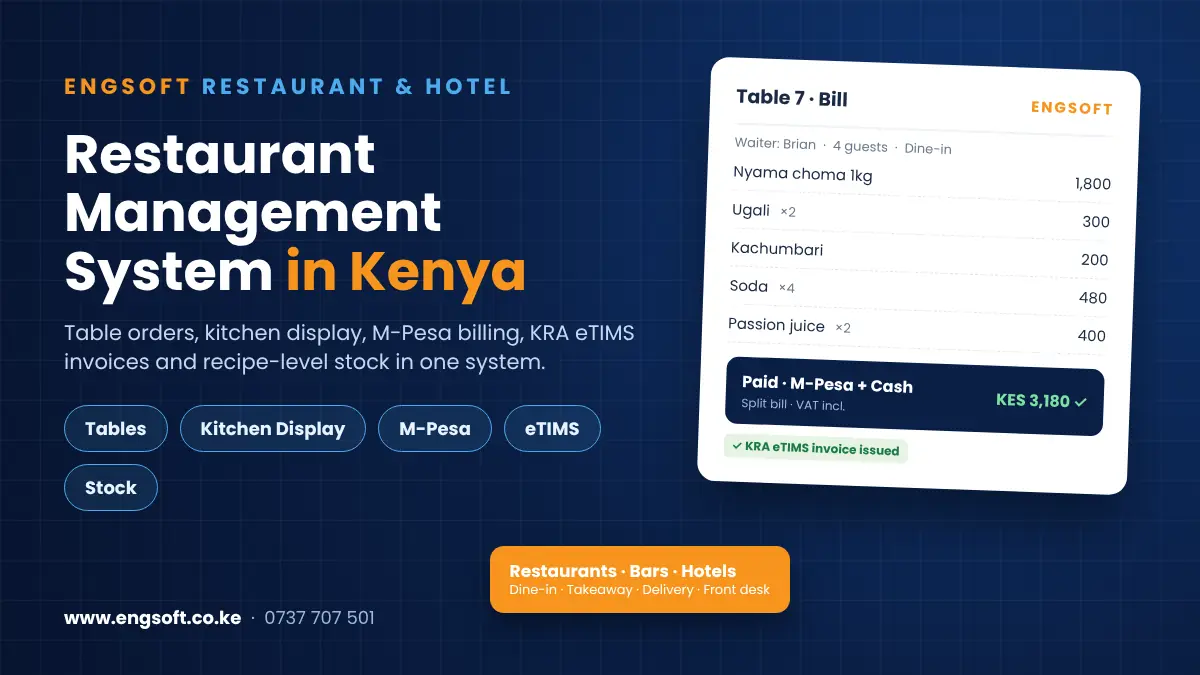
Restaurant Management System in Kenya: The Complete Guide to Restaurant and Hotel Software

A busy Friday night in a Kenyan restaurant tests everything at once. Waiters scribble orders on paper pads, the kitchen loses tickets, guests ask to split a bill four ways across M-Pesa and cash, and at closing the cashier’s till doesn’t match the sales book. By month end, the owner still can’t say which dishes make money or where the meat and drinks went.
A modern restaurant management system in Kenya fixes this by connecting the table, the kitchen, the till and the store in one platform. This guide explains what restaurant and hotel management software does, the problems it solves for Kenyan restaurants, cafés, lounges and hotels, and how to choose the right system.
What Is a Restaurant Management System?
A restaurant management system is software that runs a food business’s front of house, kitchen and back office from one database. It goes further than a basic till or POS system: an order taken at the table goes straight to the kitchen, the bill is generated from that same order, and every item sold reduces the ingredients in stock.
A complete restaurant and hotel management system typically covers:
- Table and reservation management, with a live floor plan
- Order taking for dine-in, takeaway and delivery
- Kitchen display or ticket printing, routed to the right station
- Billing and payments, including M-Pesa, card and cash on one bill
- Menu and pricing, including modifiers, combos and happy hours
- Recipe-level stock control and low-stock alerts
- Staff shifts and performance
- Sales, food cost and profitability reports
Challenges Kenyan Restaurants and Hotels Face Today
- Stock leakage. Meat, spirits and beer disappear between the store, the kitchen and the bar. Without recipe-level tracking, owners only see the loss at stock-take.
- Cash and M-Pesa reconciliation. Guests pay by M-Pesa, card and cash, often on the same bill. Matching every payment to the right order by hand is slow and invites fraud.
- Lost or slow kitchen orders. Paper tickets get misplaced, dishes for one table leave at different times, and guests wait.
- Tax compliance. KRA requires businesses to issue electronic tax invoices through TIMS or eTIMS. In September 2026 it also told businesses using these systems to keep stock-in and stock-out records in them, which makes accurate inventory records more important than ever.
- Unknown food cost. Many owners can’t say what a plate of nyama choma or a cocktail really costs them, so menu prices are guesswork.
- Staff accountability. Voids, discounts and refunds without manager approval quietly eat into profit.
Engsoft Restaurant Management System: Key Modules
Engsoft Restaurant Management System connects a front-of-house dashboard for waiters and cashiers, a kitchen display for food preparation, and a management dashboard for owners. An order taken at a table, a ticket fired to the kitchen or a payment at the till shows up immediately in sales, stock and staff reports.
Tables and reservations
- Live table map showing open, occupied, reserved and awaiting-cleanup tables
- Reservations by date, time and party size, plus a walk-in waitlist with estimated seating times
- Table assignment to waiters, and merge-table and split-bill for groups
Dine-in, takeaway and delivery orders
- One order flow for dine-in, takeaway and delivery
- Modifiers, special requests and allergen notes on every item
- Delivery dispatch to riders with status tracking, and integration with third-party delivery platforms
Kitchen display and ticket flow
- Orders routed automatically to the right kitchen or bar station, on screen or printed
- Ticket status from received to preparing to ready
- Course timing, so dishes for one table leave the kitchen together
- Ageing or delayed tickets highlighted for attention
Menu and pricing
- Menu builder with categories, items, modifiers and combos
- Time-based, channel-based and branch-based pricing, including happy hours
- Promotions, discounts and vouchers
- Menu items linked to recipes for cost and stock calculation
Stock and food cost control
- Ingredient-level inventory: stock is deducted by recipe as each item is sold
- Low-stock alerts before you run out of a best seller
- Food cost percentage and profitability by item and branch
Management dashboard
Owners see today’s sales, table occupancy, low-stock alerts, top-selling items, staff on shift and food cost % on one screen, along with staff performance by waiter and cashier, customer order history and loyalty settings.
Hotel front office
- Guest check-in and check-out
- Room billing, with restaurant, bar and room-service charges added to the guest’s bill
- Housekeeping status for every room, so the front desk knows which rooms are ready
Billing, M-Pesa, KRA eTIMS and Integrations
Fast, accurate billing keeps tables turning and the till honest:
- Itemised bills generated automatically from the table or counter order
- Split payments across cash, card and mobile money, including M-Pesa, on one bill
- Printed receipts and e-receipts
- Discount, voucher and loyalty-point redemption at checkout
- Refunds and voids only with manager approval
- Till reconciliation and end-of-shift cash-up by cashier
KRA eTIMS compliance: the system issues electronic tax invoices through KRA eTIMS for every sale, so your restaurant or hotel stays compliant without retyping sales into a separate tax system. Because stock is tracked in and out by recipe, you also have the stock records KRA now expects businesses to keep.
The restaurant system also connects to the rest of your business:
- Accounting ERP: sales and purchases post to Engsoft’s accounting system, so the books match the till.
- Payroll and biometric attendance: waiters, cooks and cashiers clock in by fingerprint, and their hours feed payroll.
- Hotels: the Yeastar Hotel App phone system and smart door locks work alongside the restaurant and bar system.
- Institutional kitchens: staff and student dining halls can use our canteen management system for biometric meal control.
Who Is It For?
- Restaurants and cafés that want faster table service and tighter stock control
- Bars, lounges and nyama choma joints where drinks and meat stock leakage is the biggest risk
- Hotels, lodges and guest houses running restaurants, bars and room-service kitchens
- Fast-food and takeaway outlets with their own riders or third-party delivery platforms
- Multi-branch chains that need branch-based pricing and one view of all outlets
- Institutional kitchens, together with our canteen management system
How to Choose a Restaurant Management System in Kenya: A Checklist
Before you buy, check that the system:
- Accepts M-Pesa, card and cash on one bill, with automatic reconciliation at the end of each shift.
- Tracks stock at ingredient level, deducting by recipe as each item is sold.
- Sends orders to the kitchen and bar automatically, with a kitchen display or printed tickets per station.
- Handles dine-in, takeaway and delivery in one order flow.
- Controls voids, refunds and discounts with manager approval and an audit trail.
- Reports food cost and profit by dish and branch, not just total sales.
- Supports your tax compliance: ask how the vendor handles KRA eTIMS invoices and the new stock-record requirements.
- Connects to accounting and payroll, so you don’t re-enter data.
- Works across branches with branch-level pricing and consolidated reports.
- Comes with local installation, training and support, including hardware such as receipt printers and kitchen screens.
Why Choose Engsoft?
- 10 years delivering business systems in Kenya
- 100+ clients across 8 countries in Africa, and 18 systems from one vendor
- One supplier for the whole venue: restaurant software, POS hardware, accounting, payroll, biometric attendance, CCTV and hotel phone systems
- Local installation, training and support from our Nairobi office
- Configurable for a single café or a multi-branch restaurant and hotel group
Frequently Asked Questions
What is a restaurant management system?
It is software that runs a restaurant’s orders, tables, kitchen tickets, billing, payments, stock and staff from one platform, with dashboards for waiters, cashiers, the kitchen and managers.
Does it accept M-Pesa?
Yes. Cash, card and mobile money payments, including M-Pesa, are supported, and a single bill can be split across several payment methods.
Does it work for hotels?
Yes. It includes a hotel front office for check-in, check-out, room billing and housekeeping, and hotels use it for their restaurants, bars and kitchens. It also works alongside Engsoft’s hotel phone system and smart lock solutions.
Is it KRA eTIMS compliant?
Yes. The system issues electronic tax invoices through KRA eTIMS for every sale, and its recipe-level stock tracking keeps the stock-in and stock-out records KRA requires.
Can it handle takeaway and delivery?
Yes. Dine-in, takeaway and delivery orders run through one order flow, with rider dispatch and integration with third-party delivery platforms.
How does it help control stock and food cost?
Each menu item is linked to a recipe, so ingredients are deducted from stock as items are sold. You get low-stock alerts and food cost percentage by dish and branch, which shows where leakage is happening.
How much does a restaurant management system cost in Kenya?
The price depends on the number of outlets, terminals and modules you need. Call 0737 707 501 or book a demo for a quote.
Book a Free Demo
See how Engsoft Restaurant Management System can speed up service, cut stock leakage and show you which dishes make money.
- Call or WhatsApp: 0737 707 501
- Email: info@engsoft.co.ke
- Visit: Repen Complex, Mombasa Road – Katani Road Junction, Nairobi (Mon–Fri 8:00–17:00, Sat 9:00–13:00)