

Access Control Systems in Kenya: The Complete Guide to Biometric, Card and Door Access Control

A lost key that nobody reports. A former employee who still has the code to the store. A server room that anyone can walk into because the door is propped open. Most security problems inside a building come down to one question: who can go where, and when?
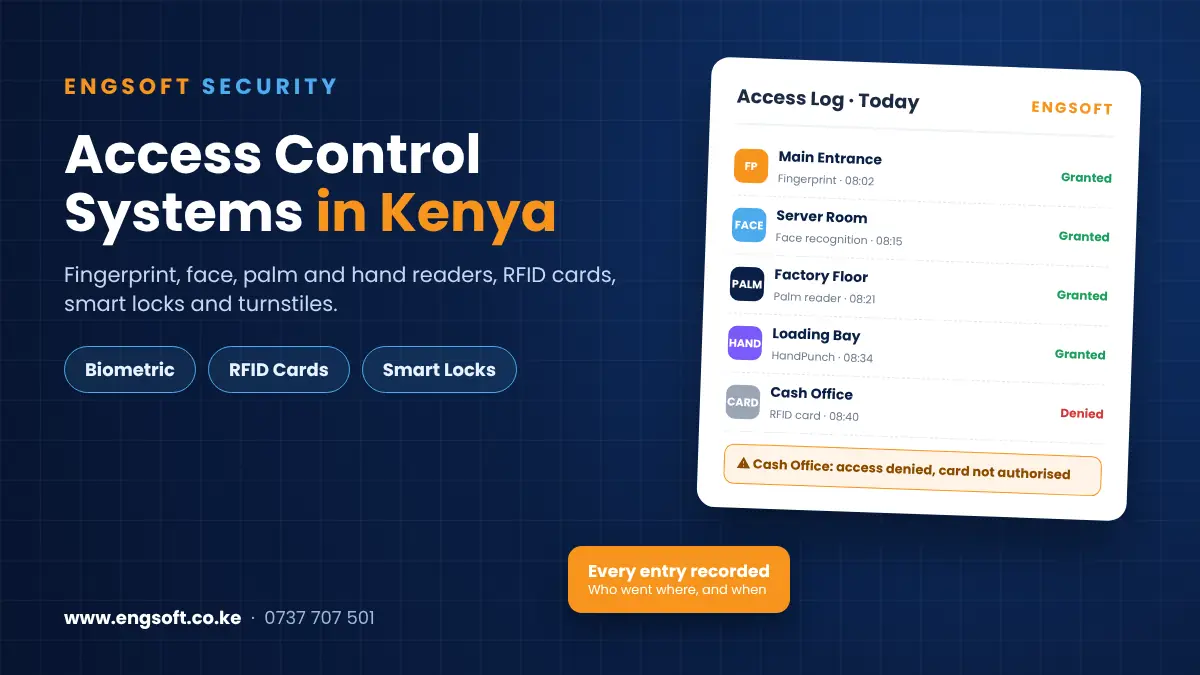
Access control systems in Kenya answer that question by replacing keys with biometrics (fingerprint, face, palm and hand), RFID cards and PINs, and by recording every entry. This guide explains how access control works, the main reader types, the problems it solves, how it connects to CCTV, turnstiles and attendance, and what to check before you choose a system and installer.
How an Access Control System Works
Every access control system has four parts:
- Readers at the door, gate or turnstile that identify the person
- A controller that checks whether that person is allowed in at that time
- An electric lock, barrier or turnstile that opens only when access is granted
- Software where you add and remove users, set access rules and view the entry log
Ways to identify people
- Proximity (RFID) cards and key fobs: fast and economical. Most door readers in Kenya use 125 kHz proximity cards, while higher-security sites use 13.56 MHz MIFARE smart cards. Cards can double as printed staff ID badges.
- PIN codes: simple keypads, often combined with a card for two-step entry.
- Biometrics: nobody can lend their finger, face or hand to a colleague, so biometrics stop shared cards and codes. There are four types:
- Fingerprint readers: the most widely used and economical biometric option.
- Face recognition readers: touchless and quick, suitable for busy entrances and hygiene-sensitive areas.
- Palm readers: read the palm without contact, and work well where fingerprints are worn or dirty, such as factories and construction sites.
- Hand readers (HandPunch): read the shape of the whole hand, a rugged choice for industrial sites and high-traffic entrances.
- Biometric smart locks: standalone keyless locks for homes, offices, hotel rooms and server rooms that open by fingerprint, face, palm, card, PIN or phone app.
Readers can be set differently for entry and exit, for example a fingerprint to enter and a card to leave, or a face and fingerprint reader on both sides for high-security rooms.
Standalone or networked
- Standalone systems control one or a few doors, with users enrolled at the device. They suit small offices, homes and single rooms.
- Networked systems connect many doors, gates and branches to central software, so you can add or block a user everywhere at once and pull reports for any door.
Common Access Control Problems in Kenyan Organisations
- Keys and codes that never change. Keys are copied, codes are shared, and when someone leaves, nobody changes the locks.
- Shared or borrowed cards. One staff member taps in for another, so the entry log no longer shows who was really there.
- No record of who entered. After a theft from the store or server room, there is no list of who opened the door and when.
- Former staff still have access. Cards and fingerprints are not removed when employees, contractors or tenants leave.
- Too many people in sensitive areas. Everyone can open every door, including cash offices, pharmacies, data centres and records rooms.
- Separate systems that don’t talk. Doors, CCTV, attendance clocks and visitor registration each run on their own, so investigating an incident means checking four places.
- Biometric data handled carelessly. Kenya’s Data Protection Act treats biometric data as sensitive personal data, so fingerprint, face, palm and hand templates need to be collected for a clear purpose and stored securely.
Engsoft Access Control Solutions: What We Supply and Install
Engsoft access control systems are designed, installed and maintained for businesses, institutions and homes of all sizes, from a single office door to multi-site networks.
Readers and devices
- Biometric access readers: fingerprint readers, face recognition readers, palm readers and HandPunch hand readers, including ZKTeco models such as the F18, FR1200 and Horus H1
- Proximity card and PIN readers for doors and gates
- Biometric smart locks that open by fingerprint, face, palm, RFID card, PIN or phone app, including hotel and outdoor models
- RFID cards: 125 kHz proximity, 13.56 MHz MIFARE and UHF, blank or printed as staff ID badges
Reader combinations
- Proximity card and PIN for in and out
- Fingerprint for in and out
- Fingerprint to enter, card to exit
- Face and fingerprint for in and out
- Proximity card for in and out
Access control software
Engsoft access control software lets you protect assets, premises, operations and information. It runs network-based or standalone, so you can manage one door or many from one place.
Our service
- Site survey and quote based on your doors, gates and traffic
- Design, installation and commissioning by experienced technicians
- Access control repairs, including systems installed by other companies
- Maintenance and support from our Nairobi office
Access Control With CCTV, Turnstiles, Visitors and Attendance
Access control is most useful when it works with the rest of your security and HR systems:
- Turnstiles and barriers: tripod, swing, flap, optical and full-height turnstiles with face, fingerprint or card readers, so only authorised people pass, one at a time.
- Entrance control and parking: vehicle barriers, biometric locks and smart parking at the gate.
- CCTV: cameras covering every controlled door, so you can match an entry event to the footage.
- Visitor management: registered visitors receive passes, and turnstiles connect to the visitor system.
- Biometric time attendance: the same card can open doors and record clock-ins, and turnstiles connect to attendance.
For an overview of every option, see our Security Systems in Kenya: The Complete 2026 Guide.
Who Is It For?
- Offices and corporates controlling entrances, server rooms, finance and HR offices
- Banks, SACCOs and microfinance institutions protecting strongrooms, cash offices and records
- Hospitals and pharmacies restricting drug stores, theatres and records rooms
- Factories and warehouses controlling stores, production floors and loading bays
- Schools, colleges and universities managing gates, hostels, labs and libraries
- Hotels and apartments using smart locks and card access for rooms, gyms and parking
- Government offices and data centres that need strict, audited access
Checklist: How to Choose an Access Control System in Kenya
- Which doors really need control? List entrances, gates and sensitive rooms, and who needs access to each.
- Card or biometric? Cards are economical. Biometrics stop shared credentials: fingerprint readers are the most economical, face recognition is fastest and touchless, and palm and hand readers suit tough environments where fingerprints wear. Many sites mix them.
- Standalone or networked? If you have many doors or branches, choose software that manages them all from one place.
- How fast can you remove someone? Check that you can block a lost card or a departing employee everywhere at once.
- What happens in a power cut? Ask about backup power for controllers and locks, and whether doors fail locked or unlocked for fire safety.
- Does it connect to your other systems? Look for integration with CCTV, turnstiles, visitor management and time attendance.
- Is biometric data protected? Check where fingerprint, face, palm and hand templates are stored, who can see them, and how staff are informed.
- Who supports it locally? Choose an installer who can repair, maintain and expand the system after installation.
Why Choose Engsoft for Access Control?
- 10 years of experience designing, installing and maintaining access control systems
- 100+ clients across 8 countries, with 18 systems from one vendor
- Card, fingerprint, face, palm, hand and smart lock options from one supplier
- We repair access control systems, including those installed by other companies
- One supplier for your full setup: access control, turnstiles, CCTV, visitor management and time attendance
- Local support from Nairobi for installation, maintenance and repairs
Frequently Asked Questions
What is an access control system?
An access control system decides who can open a door, gate or turnstile, and when. People identify themselves with a card, PIN or biometric reader (fingerprint, face, palm or hand), the controller checks their permissions, and every entry is recorded.
How much does an access control system cost in Kenya?
The cost depends on the number of doors, the reader type (card, fingerprint, face, palm or hand), the locks or turnstiles needed, cabling, and whether you need networked software. Engsoft surveys your site and gives you a quote for your exact setup.
Which is better: card, fingerprint, face, palm or hand readers?
Cards are the most economical and can double as staff ID badges. Fingerprint readers stop people sharing cards or codes at low cost. Face recognition readers are touchless and fastest at busy entrances. Palm readers and HandPunch hand readers suit factories and sites where fingerprints are worn or dirty. Many organisations combine them, for example a card plus fingerprint for sensitive rooms.
What is the difference between standalone and networked access control?
Standalone systems manage one or a few doors directly at the device. Networked systems connect many doors and branches to central software, so you can add or block users everywhere at once and see one entry log.
Can the same card be used for access control and time attendance?
Yes. One RFID card can open doors and record clock-in and clock-out times, and turnstiles can connect to biometric time attendance.
Do you install biometric smart locks for homes and hotels?
Yes. Engsoft supplies smart locks that open by fingerprint, face, palm, RFID card, PIN or phone app, including outdoor deadbolts and digital hotel locks managed from a mobile app.
Do you repair access control systems installed by another company?
Yes. Engsoft offers access control repairs as well as new installations, including systems installed by other companies.
Is it legal to use biometric access control for staff in Kenya?
Yes, but Kenya’s Data Protection Act treats biometric data as sensitive personal data. Tell staff why their fingerprint, face, palm or hand data is collected, use it only for that purpose, and store it securely.
Request a Free Access Control Quote
Tell us which doors, gates and rooms you want to control. Our team will recommend the right readers, locks and software and give you a free quote.
Request an access control quote
- Phone / WhatsApp: 0737 707 501
- Email: info@engsoft.co.ke
- Office: Repen Complex, Mombasa Road – Katani Road Junction, Nairobi
- Hours: Mon–Fri 8:00–17:00, Sat 9:00–13:00